Self-Supervised Learning and Opportunistic Inference for Continuous Monitoring of Freezing of Gait in Parkinson’s Disease
Abstract
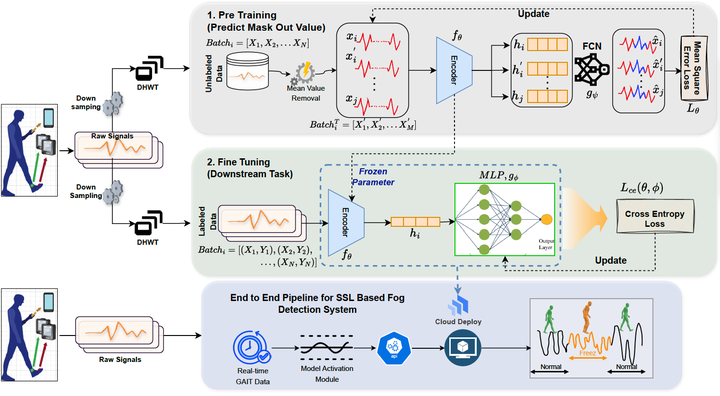
Parkinson’s disease (PD) significantly affects patients’ quality of life through debilitating motor symptoms, such as Freezing of Gait (FoG). Continuous, in-home monitoring of FoG is essential for timely clinical intervention but remains challenging due to high power consumption, annotation cost, and the controlled environments required by current wearables. We introduce LIFT-PD, a novel self-supervised learning (SSL) framework for real-time, patient-independent FoG detection that uniquely utilizes a single waist-worn accelerometer—an approach traditionally considered less optimal due to weaker gait signatures. LIFT-PD leverages SSL on unlabeled data collected from uncontrolled, real-world settings and employs a novel Differential Hopping Windowing Technique (DHWT) to address gait variability and dataset imbalance. Additionally, an opportunistic inference module selectively activates the deep learning model only during patient movement, significantly reducing power consumption and enabling continuous monitoring (>48 hours). Experimental results show that LIFT-PD achieves a 7.25% increase in precision and 4.4% improvement in accuracy compared to supervised and semi-supervised baseline models while requiring approximately 40% fewer labeled training samples. Evaluations across diverse patient characteristics-including severity, medication state, age, and gender-confirm the model’s robustness and clinical applicability, positioning LIFT-PD as a practical, energy-efficient, and scalable solution for continuous real-world FoG monitoring in PD.

Shovito Barua Soumma
Graduate Research Associate
PhD Candidate
Currently I am working on building and optimizing deep learning models for wearable sensors data.