Guest Lecture: LLMs, Agentic AI and SMART Agent Chatbot
Abstract
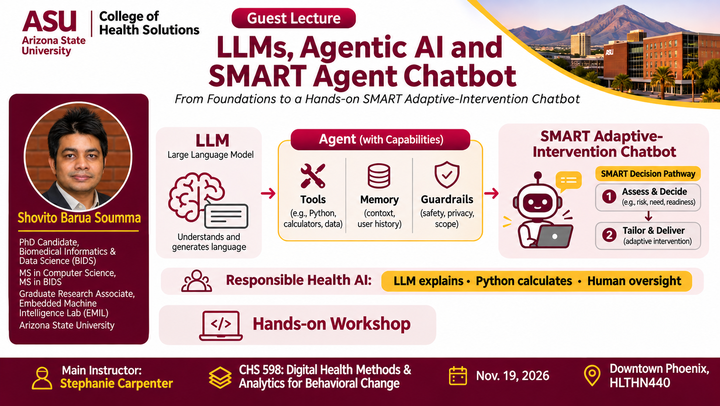
Shovito Barua Soumma delivered this guest lecture for CHS 598: Digital Health Methods & Analytics for Behavioral Change at Arizona State University, taught by Dr. Stephanie Maria Carpenter. He introduced students to the foundations of large language models (LLMs) and agentic AI, including how LLMs generate responses, how an agent extends an LLM through tools, memory, instructions, and guardrails, and how retrieval-augmented generation (RAG) can ground model responses in external evidence. He also discussed opportunities and challenges for using agentic AI in health, emphasizing privacy, safety, reliable computation, and human oversight. As a research example, he presented GlyRAG, a context-aware retrieval-augmented framework for blood glucose forecasting, to illustrate how LLM-generated contextual information can complement physiological time-series modeling. He then led a hands-on workshop in which students built and evaluated an LLM-powered chatbot for a Sequential Multiple Assignment Randomized Trial (SMART). Using fictional participant data, the agent selected approved Python tools to summarize the study, calculate response rates, perform Q-learning-based analysis, and explain adaptive intervention strategies. Students independently verified calculations, examined tool evidence, tested safety guardrails, and extended the agent with an additional analysis tool. Throughout the session, he emphasized a practical design principle for trustworthy AI in health: the LLM handles language and explanation, validated computational tools handle quantitative analysis, and humans retain oversight of the resulting decisions.

Shovito Barua Soumma
Graduate Research Associate
PhD Candidate
Currently I am working on building and optimizing deep learning models for wearable sensors data.