Stress Mindset Matters: Rethinking Mental Stress Detection with Multimodal Wearable Sensors
Abstract
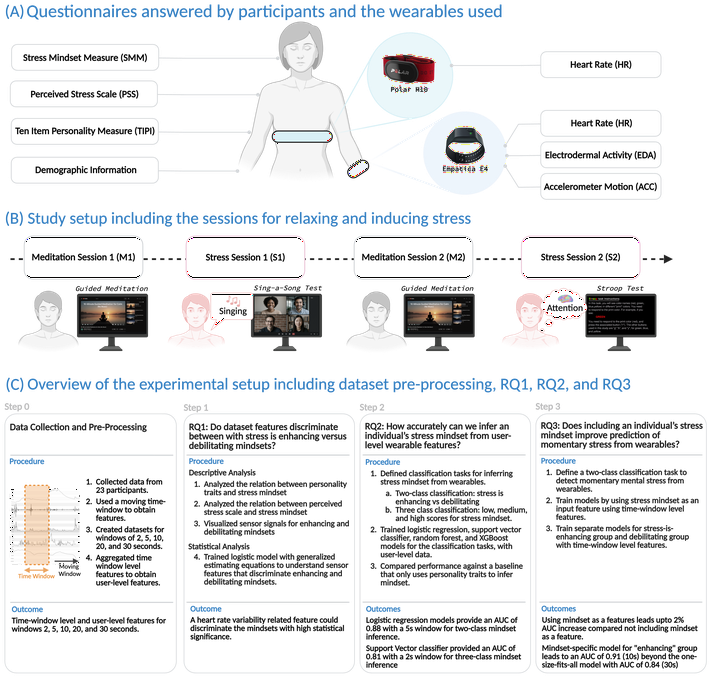
The mindset people have about stress is important to be studied because this core belief, that stress is either enhancing or debilitating, fundamentally alters a person’s physiological and psychological responses to stressors. However, this crucial construct is rarely considered in prior research on momentary stress detection with wearables, leaving two fundamental questions unanswered: can wearable data identify an individual’s stress mindset, and can mindset be leveraged to build better performing stress detection models? To investigate that, we conducted an in-lab study (N=23) with wearable devices by inducing mental stress in participants. First, we found that heart rate variability and electrodermal activity features carry signatures of stress mindset. Second, machine learning models can discriminate stress mindset with sensors, achieving AUCs upto 0.88. Finally, a random forest model trained for stressis-enhancing participants outperformed a one-size-fits-all model (AUC=0.91 vs. 0.78, p < 0.05), for the task of stress detection. Our findings show that stress mindset leaves a measurable physiological footprint and that mindset-aware models open the potential for more personalized stress detection and interventions.

Shovito Barua Soumma
Graduate Research Associate
PhD Candidate
Currently I am working on building and optimizing deep learning models for wearable sensors data.